


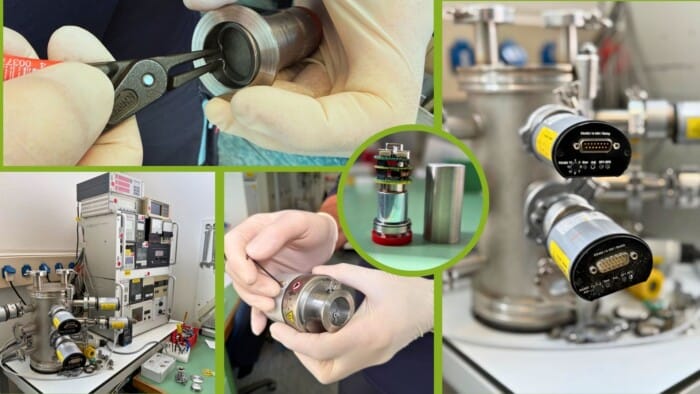
Calibrating Vacuum Sensors – Why is it necessary on a regular basis?
That’s a question our customers ask us quite often.
So, we talked to our service engineers to give you some more background on this topic.
Question 1: Why is it important to calibrate vacuum sensors regularly?
If a vacuum pump stops working, the first thing we do is check the vacuum sensor. If it hasn’t been calibrated for a long time, we first need to establish whether the correct value is being displayed. Only then can we start with the troubleshooting, which means the actual repair is delayed.
If the annual calibration recommended by ISO 9001 has been carried out, the technician knows immediately that the reading is correct and can start troubleshooting straight away, without additional delay.
Question 2: What can happen if the vacuum sensor displays incorrect readings?
Incorrect readings can increase the chamber’s pumping time. Even if it’s only a matter of seconds each time, this adds up over time. And that may result in a lower overall performance.
Furthermore, if the vacuum sensor displays a lower pressure than the real value, there may be too much air in the chamber. This can adversely affect the process and the quality of the batches. This is particularly relevant in coating and heat treatment processes.
Question 3: Are there any typical causes of inaccurate readings or malfunctioning vacuum sensors?
Yes, for example, when the vacuum pump is operating in a process environment. When cleaning the chamber, people tend to forget that the vacuum sensors are also contaminated and consequently display incorrect readings. This too can be avoided through regular calibration, as cleaning the sensors is part of the calibration process.
Furthermore, the installation position of the sensors can cause them to become contaminated quickly. Depending on the process, fitting baffles or extended connectors can often help to reduce exposure to vapours or particles.
Question 4: How does calibration usually work?
Our technicians carry out factory calibrations at our workshop in Eching. Should a DakkS calibration be required, we have a trusted partner with whom we work seamlessly.
Question 5: What documentation do customers receive following calibration?
Our customers receive a certificate that details exactly what was done during the calibration, which test method was used – and which master cell was used to carry out the comparison measurement. Master cells serve as a reference for comparison measurements and are, of course, also calibrated by us annually to ensure a stable, traceable measurement basis.
Question 6: What do you recommend to our customers?
We strongly recommend having vacuum sensors calibrated annually, as recommended by ISO 9001. This helps avoid problems and ensures that process quality, operational safety and cost control are maintained.
When was the last time you had your vacuum sensors calibrated?